









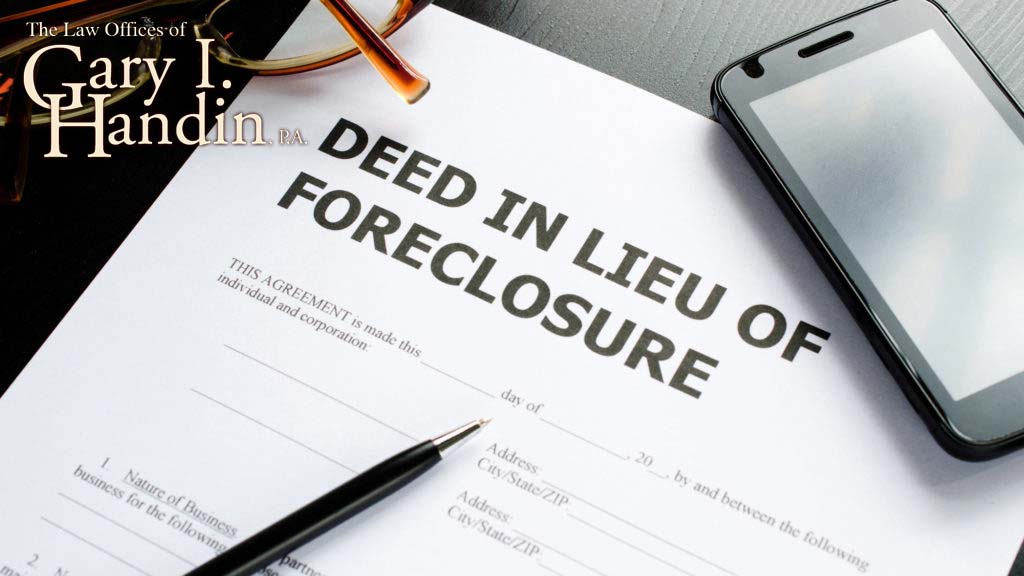
- What Is a Deed-In-Lieu of Foreclosure?
- How the Deed-In-Lieu of Foreclosure Process Works
- Understanding the Different Types of Real Estate Deeds
- Uses for Quit Claim Deeds
- How a Deed-In-Lieu of Foreclosure Affects Your Credit Score
- Why You Should Hire a Foreclosure Defense Attorney
- Contact Gary I. Handin, P.A. Today
Facing foreclosure is a distressing prospect for any homeowner. Avoiding it is of paramount importance, but to do that you need to be aware of all of your options. One of the options available to you is entering into a deed-in-lieu of foreclosure agreement. Even if you have defaulted on your mortgage payments a number of times, you can still avoid foreclosure with sound legal advice. Understanding how deeds-in-lieu work, what types of real estate deeds exist, and how quit claim deeds factor into foreclosure situations can help you make informed decisions about your property and your future.
What Is a Deed-In-Lieu of Foreclosure?
A deed in lieu of foreclosure is the process by which a homeowner voluntarily transfers ownership of their home to their lender in exchange for being released from their mortgage obligations. In this transaction, conveying the title of your home to the mortgage servicer will discharge you from your debt. Once your lender accepts the transfer of title, they will become responsible for all debt and judgments against the property.
There are two major problems which come with foreclosure. The first is that you will no longer have a place to live. The second is that it can damage your credit score immensely. Even if you are able to bounce back from the credit score impact, having a foreclosure on record could prevent you from getting another mortgage on a new house for several years to come. A deed-in-lieu of foreclosure offers a way to avoid some of these consequences while still resolving your mortgage situation.
How the Deed-In-Lieu of Foreclosure Process Works
Entering into a deed-in-lieu of foreclosure agreement requires legal knowledge. It would be in your best interest to get a legal representative that is seasoned in this field of law and that can provide you with the best possible options during this process. Below are the key steps involved.
Request a Loss Mitigation Application
To obtain a deed in lieu of foreclosure, you, the borrower, will need to request a loss mitigation application from your lender. Your application will include all relevant information regarding your income, monthly expenses, and proof thereof. This is the first step in demonstrating to your lender that you are unable to continue making your mortgage payments.
Selling Your Property First
Your lender might not accept your deed-in-lieu application the first time. Often lenders require that you list your home before the submission of your application. You may be required to provide your lender with proof of your attempted sale by means of a listing agreement. This requirement exists because lenders want to see that other options have been explored before agreeing to accept the property back.
Successful Application and Documentation
Once your application is successful, you will be provided with various documents to sign. The documents will set out the details of your agreement with the lender. They will also include conveyancing documents to transfer ownership of the property from you to the lender. It is of utmost importance that you understand the agreement before you sign. Legal terms may be complicated, but with a lawyer by your side you cannot go wrong.
Your lawyer will need to draw up a deed-in-lieu of foreclosure on your behalf. The deed must contain all the legal details to ensure the successful conveyancing of the property.
Understanding the Different Types of Real Estate Deeds
To fully understand how a deed-in-lieu of foreclosure works, it helps to know about the different types of real estate deeds which are used to convey property from one person to another. There are three types of real estate deeds: the quit claim deed, the general warranty deed, and the special warranty deed.
The Quit Claim Deed
The main difference between a quit claim deed and general and special warranty deeds is the fact that the quit claim deed contains no warranty of title. The quit claim deed can be used to transfer interest or ownership in real property from one party to another with no guarantees. Basically it says: “I don’t know what title I have or how good it is, but whatever interest I have, I give it to you.”
Due to the fact that a quit claim deed offers no warranty, it is often used to add a person’s name to a property title, transfer property among family members, as well as other specialized cases. For more detailed guidance on quit claim deeds, see our article on important tips on quitclaim deeds.
The General Warranty Deed
The general warranty deed ensures that the buyer is able to legally purchase the property in question. This type of deed is set up in a way which gives the buyer warranties from the seller due to loss incurred and claims by a third party. It provides the most protection of any deed type.
The Special Warranty Deed
The special warranty deed is in most part similar to the general warranty deed, however it deals with warranties to the buyer against only defects which might have arisen during the seller’s period of ownership. Unlike a general warranty deed, a special warranty deed does not cover issues that may have existed before the seller took ownership of the property.
Uses for Quit Claim Deeds
While quit claim deeds play a role in foreclosure situations, they are also commonly used in other legal contexts. Understanding these uses helps illustrate both the versatility and limitations of this type of deed.
Quit Claim in Probate
The probate process is a legal process in which the heirs of an estate have to go through to determine ownership. This involves going to probate court and filing the correct documentation to name an executor. A quit claim deed may be used here to transfer interest of the property to the relevant heirs.
Quit Claim in Divorce
Quit claim deeds are often used in divorce proceedings to allow for a spouse to revoke their interest in a given property, thus allowing claim of said property to go to the other spouse. It is important to note that a quit claim deed does not transfer the debt of the property over to the spouse. The quit claim deed only transfers the property interest, not the mortgage obligation.
Quit Claim in Foreclosure
It is important to note that a quit claim deed does not absolve the person executing the quit claim deed from mortgage obligations, only their interest in the property. However, by relinquishing the rights to your home to the lender holding the mortgage by means of a deed in lieu of foreclosure, you are able to avoid a damaging credit score impact.
The quit claim deed is not a magic solution against foreclosure as it can only be used to help limit the damage to your credit rating. It does not, on its own, release you from the underlying mortgage debt. This is why working with an experienced attorney is so important when navigating these situations.
How a Deed-In-Lieu of Foreclosure Affects Your Credit Score
Foreclosures are associated with a poor debtor-creditor relationship. Once your property has been foreclosed, you may see a several hundred point drop in your credit score. The foreclosure will remain on your credit history for 7 years. When applying for future loans, you will have to disclose that you have had a property foreclosed upon. You would be eligible to buy a home in 5 years with some restrictions, and in 7 years’ time you will be eligible to purchase a home free of restrictions.
The effect of a deed-in-lieu is not specifically clear and the effect thereof is somewhat subjective. Generally, people report a drop of around 85 to 160 points to their credit score. A deed-in-lieu might be better because some lenders view it as displaying a greater sense of financial responsibility and willingness to pay off debts sooner rather than later.
When comparing these two options, the differences in credit impact are significant:
- Foreclosure: A several hundred point drop in your credit score, remains on credit history for 7 years, and must be disclosed when applying for future loans.
- Deed-in-Lieu of Foreclosure: An approximate 85 to 160 point drop in your credit score, and may be viewed more favorably by future lenders as it demonstrates financial responsibility.
If you are weighing a deed-in-lieu against a short sale, our article on deed-in-lieu of foreclosure vs. short sale explores those differences in detail.
Why You Should Hire a Foreclosure Defense Attorney
Real estate law can become very daunting when you consider that every state has different legal rules regarding the process. However, this does not have to be the case, as there are specialized attorneys who can help you throughout the process.
An experienced foreclosure defense attorney can:
- Ensure that all your options are considered and pursued, including deed-in-lieu agreements, loan modifications, and short sales
- Draw up the deed-in-lieu of foreclosure agreement on your behalf with all the required legal details
- Ensure that your legal interests are protected throughout the transaction
- Help you understand the difference between transferring property interest through a quit claim deed and actually being released from your mortgage obligations
- Ensure the successful conveyancing of the property and that the agreement properly discharges you from your debt
Contact Gary I. Handin, P.A. Today
At Gary I. Handin, P.A., we offer a wide variety of legal services including foreclosure defense in Florida which deals specifically with Florida law. Whether you are considering a deed-in-lieu of foreclosure, need guidance on how quit claim deeds work in your situation, or want to explore all available options to avoid foreclosure, our team is here to help. With our legal expertise we can ensure peace of mind.
Contact Gary I. Handin, P.A. today at 954-796-9600 to discuss your options. We will ensure that all your options are considered and pursued, and that your legal interests are protected throughout the process.